
Last week I was part of a Facebook discussion with a group of designers and artists about the artistic nature of Berndnaut Smilde’s Nimbus Cloud Installations. In the video below, the artist clearly states that he doesn’t like people seeing the behind the scenes of this and just likes to capture the image of the cloud in the space as the art piece.
The discussion lead me to some new conclusions about “What is business theater?”, a term that was used by B. Joseph Pine II and James H. Gilmore in 1999’s The Experience Economy. The video below is a great synopsis, as is this piece by the authors in the Harvard Business Review.
In essence, the Experience Economy posits that Experiences are a new type of economic value, distinct from commodities, goods, and services. When the book came out in 1999 there was no social media and no iPhones so this was an era far before Instagram, FOMO, and Influencer Culture. But looking back, the fact that experiences were the new currency for business could have easily predicted our current era.
And why is the business theater of The Experience Economy 2.0 and not 1.0? Because Bathtubs Over Broadway showed us that long before the Experience Economy there actually was honest to god Business Theater.
On a much more private scale, these corporate musicals provided sales teams with the IRL experiences that would resonate with them. Jump forward a few decades and still long before Instagram and the Instagrammable moments of The Color Factory and The Museum of Ice Cream, Pine and Gilmore noted that successful brands would be the ones that offered consumer experiences that help solidify the brand in one’s mind by providing a physical, tangible and memorable experience of that brand.

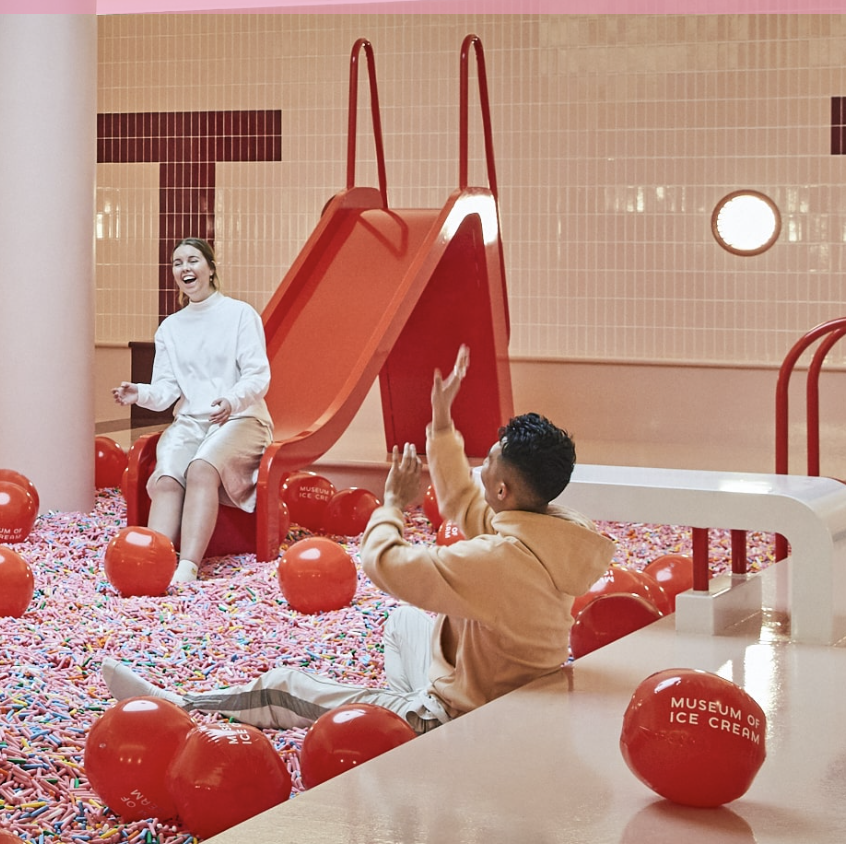
When the book came out in 1999, Niketown was already 10 years old so it wasn’t completely unheard of to provide these experiences, but the idea of brand activations and IRL brand moments were in their infancy (and corporate musicals were 30 years in the rear view mirror).


The essence of the Experience Economy is that brands were not just aspirational, they were participatory. You actually would be able to live the brand. And today we see that everywhere in venues like M & Ms World, The Porsche Experience Center, and Refinery 29’s 29 Rooms. What used to be only at Olympic Pavilions was now at SXSW, The Super Bowl, your local mall, and The Fyre Festival (had it gone off).
Now to get back to the original Facebook conversation about the Cloud Installation. Instagram and social media in general have helped telegraph the Experience Economy to you via your screens. The countless pictures of gift bags and activation selfies show you that the Experience Economy is thriving. Although many brands have become participatory, much of this participation is quite exclusive (invite only, ticketed, curated or paid influencer content) and the average consumer is often still left to aspire to participate. Just look at how quickly The Color Factory, Museum of Ice Cream and Fyre Festival sold out.

Now, let’s frame the Cloud Art discussion. The main topics dropped into three buckets:
-
Was it art at all?
-
Is it installation art?
-
Is it something else entirely?
First, is it art? Certainly it is. The artist has his materials (from Wired):
“His materials are little more than smoke and water vapor, and the results vary with the size and temperature of the location. The space must be cold and damp, with no air circulation.”
Second, is it installation art? No, the art is not the installation itself, the art is the photograph of the cloud in the space (also from Wired):
“The artist tinkers with the formula for a few days until he’s created what he believes to be the ideal cloud. For one shoot, he might create 100 clouds to get the image.”
Which then brings us to the last question, is it something else entirely? With the Experience Economy and Instagram as our backdrops, I propose that this is something different. It is art, but not in the traditional sense. The piece of art is a perfect instagrammable moment in time. It is one of those images that has you asking, “What is that? I gotta click and see!” the same way the Grand Canyon Sky Bridge has you asking, “Where is that? I gotta go!”

This different thing entirely is art in the instagram age. It is The Museum of Ice Cream and The Color Factory all wrapped up into a single photograph. Social media, and the photograph on social media is an amplifier for the brand (or artist in this case).
And that’s not a bad thing. We are talking about Berndnaut and his work which shows that what he is doing is working at getting his art and brand out there. And this brings us back to the idea of Business Theater. The Experience Economy provides participatory theatrical moments for the consumer which is part of the story, but also, as consumers participate in the brand the brand evolves over time and that fourth-dimensional aspect makes brands theatrical. Then there is also the breaking the fourth wall aspect wherein consumers become the actors. Pip’s Island was a perfect example of theater in the age of the Experience Economy.
What this shows us is that art and theater (and theater is really just four-dimensional art) in these new forms are changing the monetization of art. We are also seeing museums (Spyscape and the 007 Elements Experience are two of the best examples) take this leap. And that same change can be applied to brands in the Experience Economy.
We’ll have to see where it goes and how this art is perceived once Instagram and social media culture fade. But at the moment, this piece of Cloud Art and the way it resonates perfectly encapsulates the importance and strength of the Experience Economy and how social media is perfectly poised to resonate branded experiences in that economy.
And let’s not forget that Pine and Gilmore outline what comes next after the the Experience Economy. Where the Experience Economy lets you participate in the brand, the next phase, The Transformation Economy, actually uses these experiences to transform you. At its core, the idea was that the brand actually makes you and the world better. And we are starting to see glimpses of the Transformation Economy with brands whose values echo equality, diversity, sustainability, and the fight against climate change. But, when I look at social media today, The Transformation Economy looks more like a superficial transformation of getting a tattoo, changing your make-up, and buying a t-shirt that highlights your pecs and shoulders and hides the rest of your dad bod.
Only time will tell.
 Experiential Ideas
Leave a comment