
Marty Neumeier has always looked at branding differently and challenged designers to do the same. It is important because if your brand isn’t different, then how do you stand out from the other offerings in your category? His book, Zag, is one of the most important brand reads out there. Along with Zag, I highly recommend Luke William’s (Frog Design and NYU) book, Disrupt.
In both Zag and Disrupt, the point is to find a unique point of view for your brand. When the other brands zig, Neumeier says ZAG! And I write about this here because it doesn’t just apply to brands. When you are designing an experience, that experience needs to stand out from the crowd. With so many other pieces of content (phones, billboards, other exhibits) that are fighting for attention, you need to think about how to make your experience ZAG.
The following tools are taken from Marty’s now closed brand agency, Neutron (it has been replaced by Liquid). They use these tools to help define, refine, and differentiate. And they just don’t apply to brands, you can use these same tools to help differentiate an experience.

First is the onlyness statement which helps define your main differentiator.
“Onlyness is by far the most powerful test of a strategic position. Brands need strong positioning because customers have choices—if you don’t stand out, you lose.”
The importance of an onlyness statement in branding cannot be understated. Luke Williams dedicated the entire book to just this topic of finding new business models that are tangential to traditional ones but still not the same as everyone else in the space. The onlyness statement is the path to finding what it is that makes your brand or experience different.
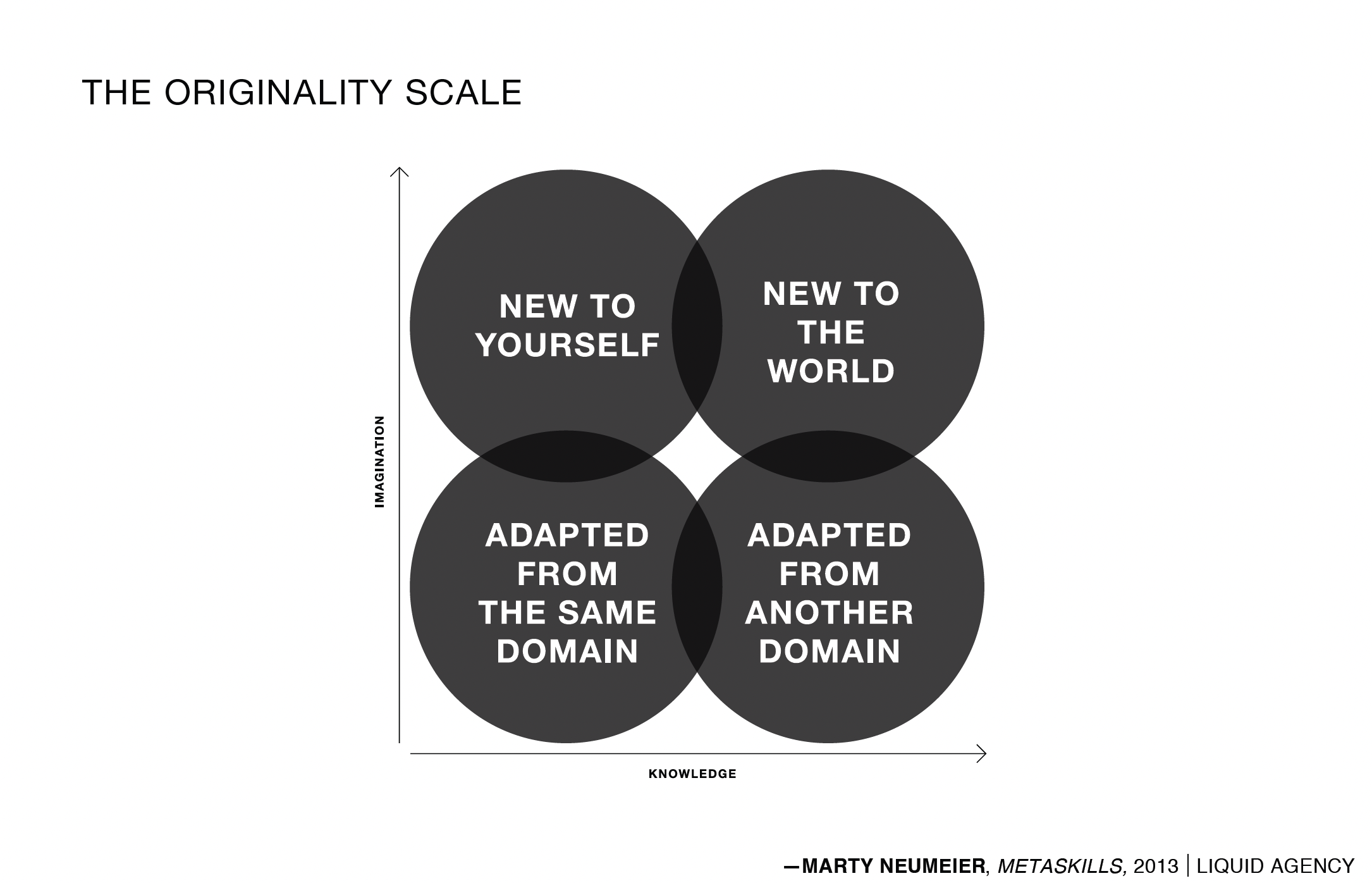
Next up is the originality scale. During brainstorming exercises, pulling from existing sources (within or outside of the experiential arena) can serve as a starting point, but finding something truly unique is sure to attract more attention and be more of a Zag.
One of the best ways to do this is to disassociate the brainstorm session from the actual solution. Instead of saying, “brainstorm ways to express the brand in a 3D space”, try these out:
-
If the client brand experience were an amusement park ride, how would you describe that ride? Write a narrative of the guest journey. Is it a dark ride? A roller coaster or a kiddy ride?
-
If the client brand experience were a movie, what type of movie would it be? A thriller? A comedy? Write a quick elevator pitch of the type of movie that would represent the brand. What is the first plot twist that derails the protagonist? What is the death experience that leads to the resolution?
Armed with the brainstorm results, it is easy to find through lines that can then be applied to the brand experience. Keep in mind that the solution doesn’t have to fall into the “New to the World” category. It isn’t always possible to be in that space. Wherever the experience does fall, it needs to be different enough.

Once you know how your experience will differentiate itself, you have to give the concept a name (and we all know how much designers hate writing). Neumeier’s 6 naming styles help to jumpstart the selection of a name for your concept.
Marty’s site provides several other great tools in the Steal This Idea section. The next time you are faced with differentiating your brand or differentiating an experience, use these tools to find a new path.
 Experiential Ideas
Leave a comment