
In 1997, following closely on the heels of Seven, David Fincher’s third film, The Game, was released. In an early scene, a Consumer Recreation Services (CRS) employee discusses with Nicholas Van Orton (Michael Douglas) what his brother has purchased for him. The conversation remains purposefully cryptic, both for the protagonist’s and the audience’s benefit.
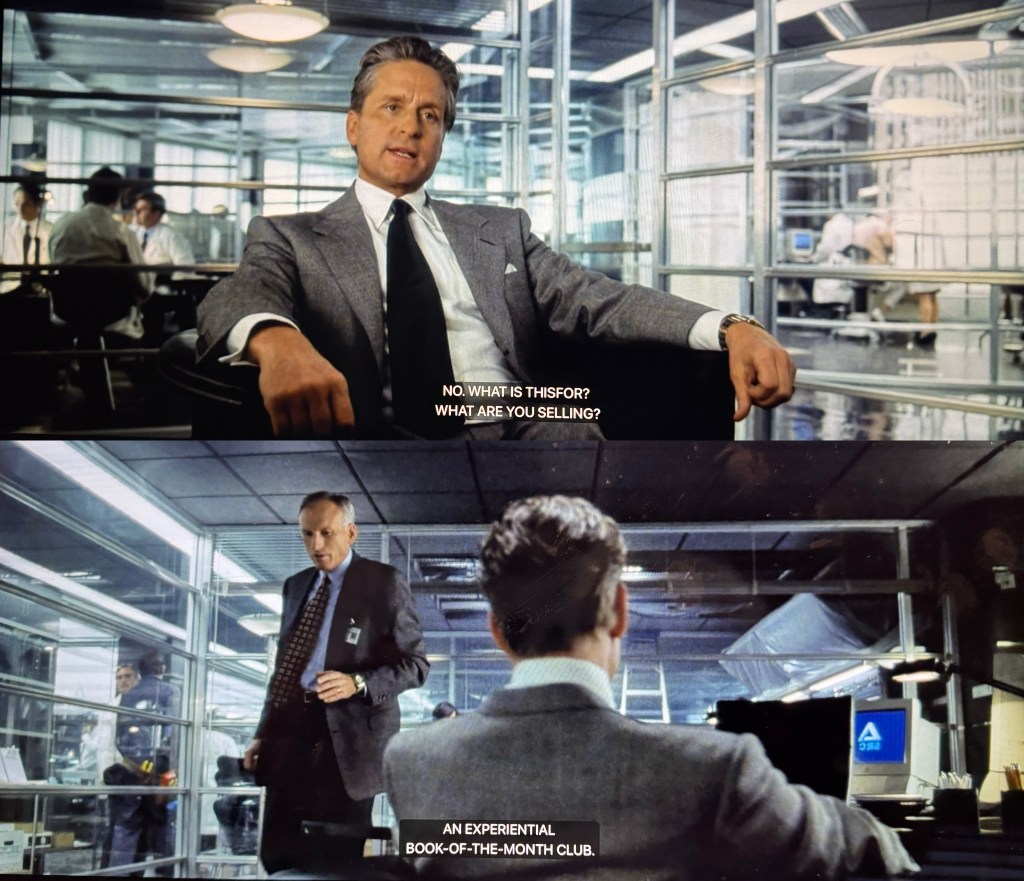
Upon rewatching the film recently, I was struck by the fact that several years before The Experience Economy was published, the screenplay already contained language and ideas that anticipated it. I was stunned when I realized these words were written for the screenplay years before The Experience Economy was published.
What is this for? What are you selling?”
Nicholas Van Orton
We’re like an experiential Book-of-the-Month Club
Jim Feingold
Warning: Spoilers ahead
Hearing the word experiential, I paused to check the film’s release year. Sure enough, it predates The Experience Economy. But that’s not the most exciting part. What truly caught me off guard was that Van Orton’s game is not only experiential, it’s transformational.
You might argue that a good screenplay should leave us with a transformed protagonist. However, it’s rare for a film’s context and plot to be a purposeful game designed to transform its lead. Nicholas’s brother Conrad, who buys him The Game for his birthday, knows Nicholas needs a wake-up call. He’s cranky, cantankerous, and unhappy.
Conflict is central to transformation in the three-act screenplay structure, but in The Game, the game itself is the sole source of conflict. To get the desired results (and five star reviews), each participant’s CRS game must be a well-researched, personalized, and authentic immersive experience, meant to push them to, and beyond, the edge. And as we see through the non-stop action and confusion, that is certainly the case for Nicholas.
More than two years before The Experience Economy hinted at the coming transformation economy, CRS was already there, possibly one of the first transformational brands. Interestingly, CRS isn’t a brand in the traditional sense. Each game is a custom-designed, personalized immersive brand experience that leaves you transformed, and perhaps in need of a little medical attention. But, as the saying goes, no one said change was easy.
There’s much to unpack and learn from CRS about building a transformational brand. So, give The Game a rewatch and consider how it draws in the customer, immerses them in the brand, packages transformation, and ultimately helps the customer reach a heightened state of awareness and personal satisfaction.
 Experiential Ideas
Leave a comment